
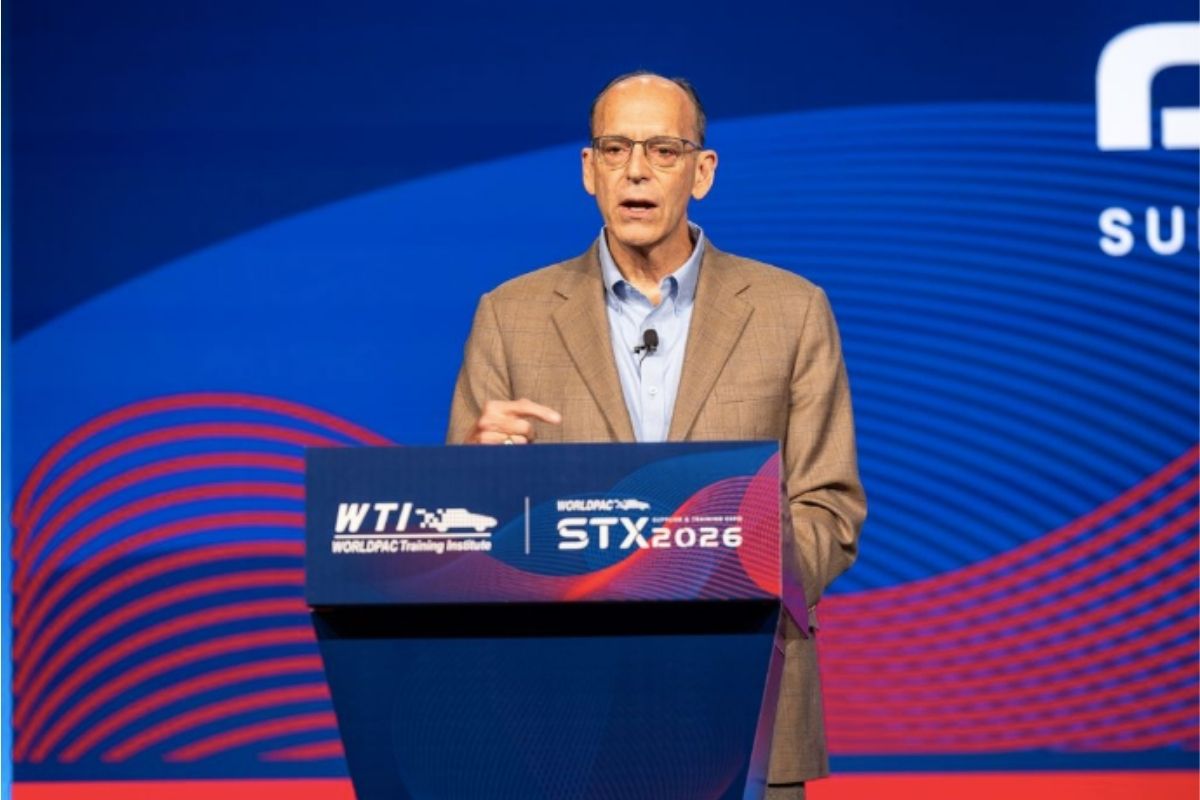
John Hamilton, CEO of Worldpac at STX 2026 Opening Session.
Worldpac is seeing stronger unit growth in Canada than in the U.S. as the automotive aftermarket distributor continues to invest in its business following its separation from Advance Auto Parts.
We sat down with John Hamilton, CEO of Worldpac, at this year’s Supplier & Trade Expo in Washington, D.C. to catch up on post-separation success and a temp-check on the Canadian side.
Hamilton said the company’s Canadian unit sales are up approximately 9% year over year, (versus an approximate average growth of 1.5%). This boost is prompting the distributor to add delivery routes and consider opening two additional branches.
“We like what’s going on there,” Hamilton said.
Worldpac became an independent company in late 2024 after Advance Auto Parts sold the business to investment firm Carlyle for $1.5 billion. Prior to the sale, Worldpac generated approximately $2.1 billion in annual revenue.
Hamilton said the change in ownership has allowed Worldpac to reinvest more of the money it generates back into the business.
“The money that Worldpac made in the past, Advance Auto Parts took,” Hamilton said. “The money that we make now, we keep, then we put it into our own investments.”
Since becoming independent, Hamilton said Worldpac has invested an additional $150 million in inventory and tripled its capital expenditure budget. The company has also established a digital transformation office and invested in artificial intelligence capabilities.
In Canada, those investments are translating into expanded distribution capacity. Hamilton said Worldpac has doubled the size of its major distribution centers in recent years, while also adding branches, delivery routes and product lines.
The company recently added a branch in Alberta and has expanded availability of brands such as ACDelco across more of the country. Hamilton said ACDelco had previously been particularly popular in the Maritimes and British Columbia, but Worldpac now carries the brand from Ontario through Manitoba, Saskatchewan and Alberta.
Hamilton said the fundamental needs of Canadian repair shops are not significantly different from those in the U.S., and that ‘the same fundamental customer need” exists in both markets: “I need my part, and I need it right now.”
That makes distribution infrastructure — including large distribution centers, strategically located branches, delivery routes and broad inventory — critical to Worldpac’s strategy in Canada.
When asked about trade complications between borders, Hamilton said recent changes in Canada-U.S. trade relations have not significantly altered Worldpac’s approach to the Canadian market.
Most of the trade issues the company deals with are related to country of origin, he clarified, rather than where a product crosses the border.
Worldpac does move inventory between Canada and the U.S. when supply is needed in one market and available in another, but Hamilton said the broader tariff environment has not fundamentally changed the company’s strategy.
He did, however, point to differences in tariff treatment of overseas products as one factor potentially affecting the two markets. He notes that the higher U.S. tariff barriers may have contributed to greater price pressure in the U.S. aftermarket, particularly among price-sensitive customers.
Looking forward, the company is looking to build on that momentum with additional routes and potentially two more Canadian branches.
For Worldpac, the strategy is straightforward: put more inventory closer to customers and expand the infrastructure needed to get parts to repair shops when they need them.
Hear the Whole Conversation
0 Comments