
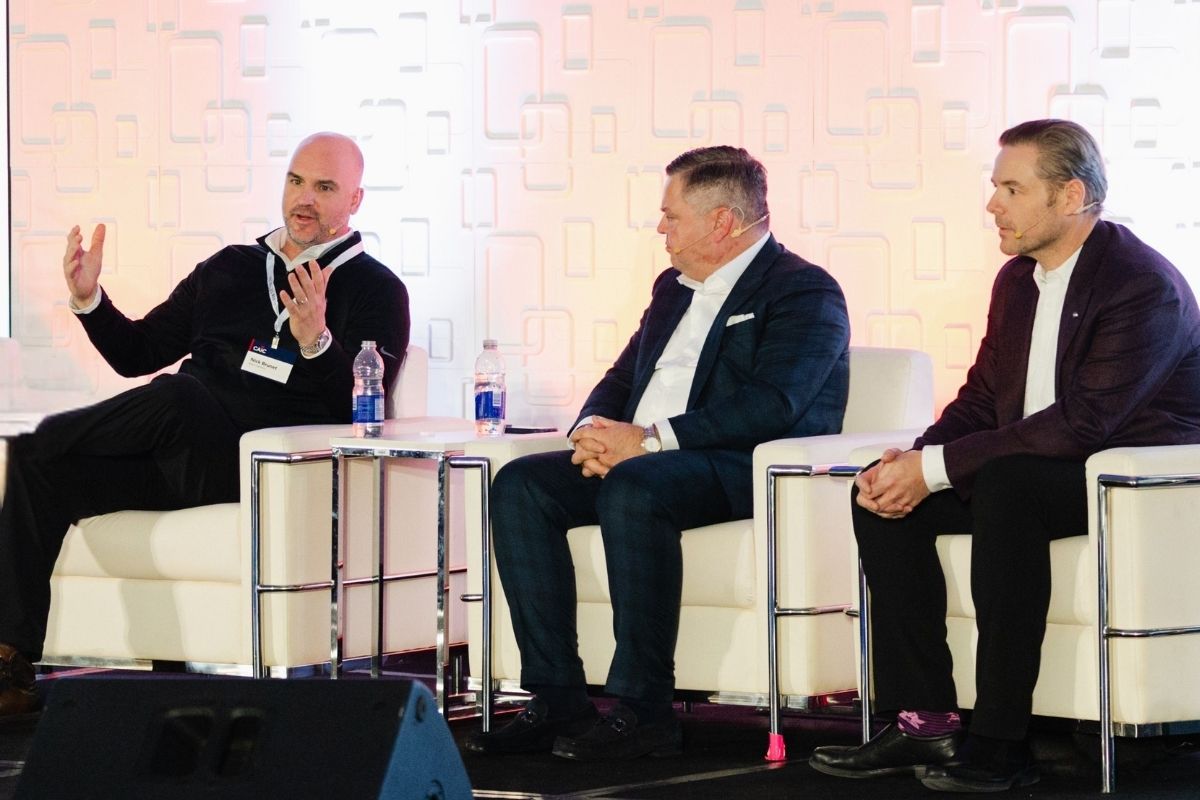
Bestbuy’s Nick Brunet, pictured at left, was joined by Alain Primeau, UAP Inc., and Nick Field, Uni-Select at the recent Canadian Auto Care Industry Conference, where the three industry leaders weighed in on the changes artificial intelligence is bound to bring to today’s aftermarket — and tomorrow’s.
Among the more compelling discussions at AIA Canada’s recent Canadian Auto Care Industry Conference was a panel featuring three senior distribution executives tackling a hot topic: artificial intelligence.
The takeaway for Jobber Nation readers? AI is arriving quickly and is already delivering real gains, but it hasn’t fundamentally changed what success looks like for aftermarket distributors — at least, not yet.
What it is doing is sharpening the tools.
Nick Brunet, Bestbuy Distributors: Efficiency First
For Bestbuy Distributors president and CEO Nick Brunet, AI is less about disruption and more about refinement.
“From our perspective, AI is a tool we can use to weed out inefficiencies within our own network,” he said.
Brunet pointed to the growing use of AI layered onto existing systems — particularly around inventory management. While not yet fully embedded into core ERP platforms, AI modules are being “bolted on” to enhance visibility and forecasting.
“We’re using predictive analytics for inventory, seasonality, and stockouts,” he explained. “The goal is to be more efficient inventory-wise and really focus on productivity.”
That focus is important. Brunet was clear that AI is not about replacing people; it’s about making them more effective.
“AI isn’t going to replace individuals. It’s going to make them more productive and allow them to focus on value-added tasks, instead of the mundane data analysis that can take up 20 to 30 per cent of someone’s day.”
In practical terms, that means tasks that once took hours — or longer — are now being handled in seconds.
For distributors, the message is straightforward: the early wins in AI are operational: better inventory decisions, fewer stockouts, and more productive teams.
Alain Primeau, UAP Inc.: The Future is Predictive
Alain Primeau, president of UAP Inc., took a broader, more forward-looking view, framing AI within the context of industry change and generational transition.
“We’re in a very exciting period in the history of the aftermarket,” he said, pointing to the ongoing challenge of succession across the industry.
Technology, he suggests, will play a critical role in bridging that gap.
UAP, as part of the global Genuine Parts Company network, is investing heavily in new capabilities. The goal is not just incremental improvement, but transformation in how the aftermarket anticipates and responds to customer needs.
“What it’s going to bring is the ability to predict the needs of the driver and the vehicle owner,” Primeau said. “The call will come in, and we’ll already know where the part is coming from. It may not even be in the garage yet, and the part will already be there.”
That vision — predictive, pre-positioned inventory tied directly to vehicle needs —represents a significant shift in how the aftermarket operates.
But Primeau also framed it in competitive terms.
“As an industry, we need to be stronger than the OEM,” he said. “We need to work together, but at the end of the day, we have to be better. That’s what the consumer expects.”
For a new generation entering both the workforce and the customer base, technology isn’t optional; it’s expected.
“The more technology we can offer them, the more engaged they’ll be,” he added.
Nick Field, Uni-Select: Turning Data into Competitive Advantage
Nick Field, vice-president of sales at Uni-Select Inc., brought a pragmatic and, at times, blunt assessment of what AI really is and how it should be used.
“At its core, AI is a collective knowledge base,” he said. “A large language model gives everyone access to a bachelor-level understanding of virtually any topic.”
On its own, that’s interesting; in the hands of a skilled operator, it becomes powerful.
“If you give a subject matter expert that level of access, that’s where the advantage is,” Field noted.
For distributors, the opportunity is clear: combine existing expertise with AI-driven insight to move faster and serve customers better.
But Field also cautioned that success depends on how organizations approach the technology.
“If you embrace it from the top down with the right governance and data security, you’re going to gain market share,” he said. “You’re going to use these tools to outcompete.”
The real value, however, lies in solving customer problems, not internal ones.
“We’re not trying to solve our own ego problems. We’re trying to solve what the market needs from us.”
That’s where concepts like “connected selling” come into play.
Field pointed to a familiar scenario: a busy shop with bays booked weeks out. If a technician is replacing rear brakes on a popular model — say, an F-150 — but hasn’t ordered all the required components, AI can flag the gap.
“AI can detect that 70 per cent of those jobs require an additional part that hasn’t been ordered,” he said. “Now the counterperson can act before it becomes a problem.”
The result? Less hoist time lost, faster job completion, and improved shop profitability.
“That’s real value, for the customer and for the industry.”
The Jobber Takeaway: Evolution, Not Revolution
Taken together, the panel delivered a consistent message.
AI is not rewriting the rules of aftermarket distribution — at least, not yet. The fundamentals remain the same: availability, service, relationships, and execution.
What AI is doing is accelerating those fundamentals.
- Better data is improving inventory decisions;
- Predictive tools are reducing friction in the repair process;
- Teams are becoming more productive, not smaller;
- Customer expectations — especially around speed and accuracy — are rising.
For jobbers and wholesalers, the implication is clear: the competitive gap will increasingly come down to how well you leverage these tools.
That’s because while AI may not replace people, it will absolutely differentiate between those who use it effectively, and those who don’t.
And in a market where every minute of hoist time counts, that difference adds up quickly.
This article also appeared in the March/April 2026 print edition of Jobber Nation. You can read the full DIGITAL FLIPBOOK HERE.
0 Comments